Fascia Focused Movement - FAMO
What is fascia?
While researchers and scientists are still working toward a definition that everyone agrees on, we can—for now—describe fascia as the environment of the body.
Fascia is the bodywide connective tissue where every single cell of our body lives. It connects systems, separates systems, and allows everything to communicate with everything else.
I like to think of it like the ocean.
Different kinds of fish live in the ocean. There is water, plants, currents, depth, and pressure. Fish communicate through sound waves, using the conductive quality of water. The ocean is not just a background—it is an active, intelligent environment that makes life and communication possible.
Fascia works in a very similar way.
From a movement perspective, the quality of this environment matters deeply. If the fascial layers are well hydrated and able to glide, movement can travel smoothly through the body. If this environment becomes more gluey or sticky, movement gets interrupted. Force no longer transfers efficiently from one area to another, and we may start to feel restricted, stiff, or “stuck” in certain places.
Keeping this environment healthy and responsive supports better function, greater movement freedom, and more ease in the body.
What is Fascia Focused Movement (FAMO)?
Fascia Focused Movement, or FAMO, is a training method that focuses on 12 distinct fascial movement qualities—such as elasticity, response-ability, and efficient force transmission—to create the best possible internal environment for the body to reach its full potential.
And it starts with intention.
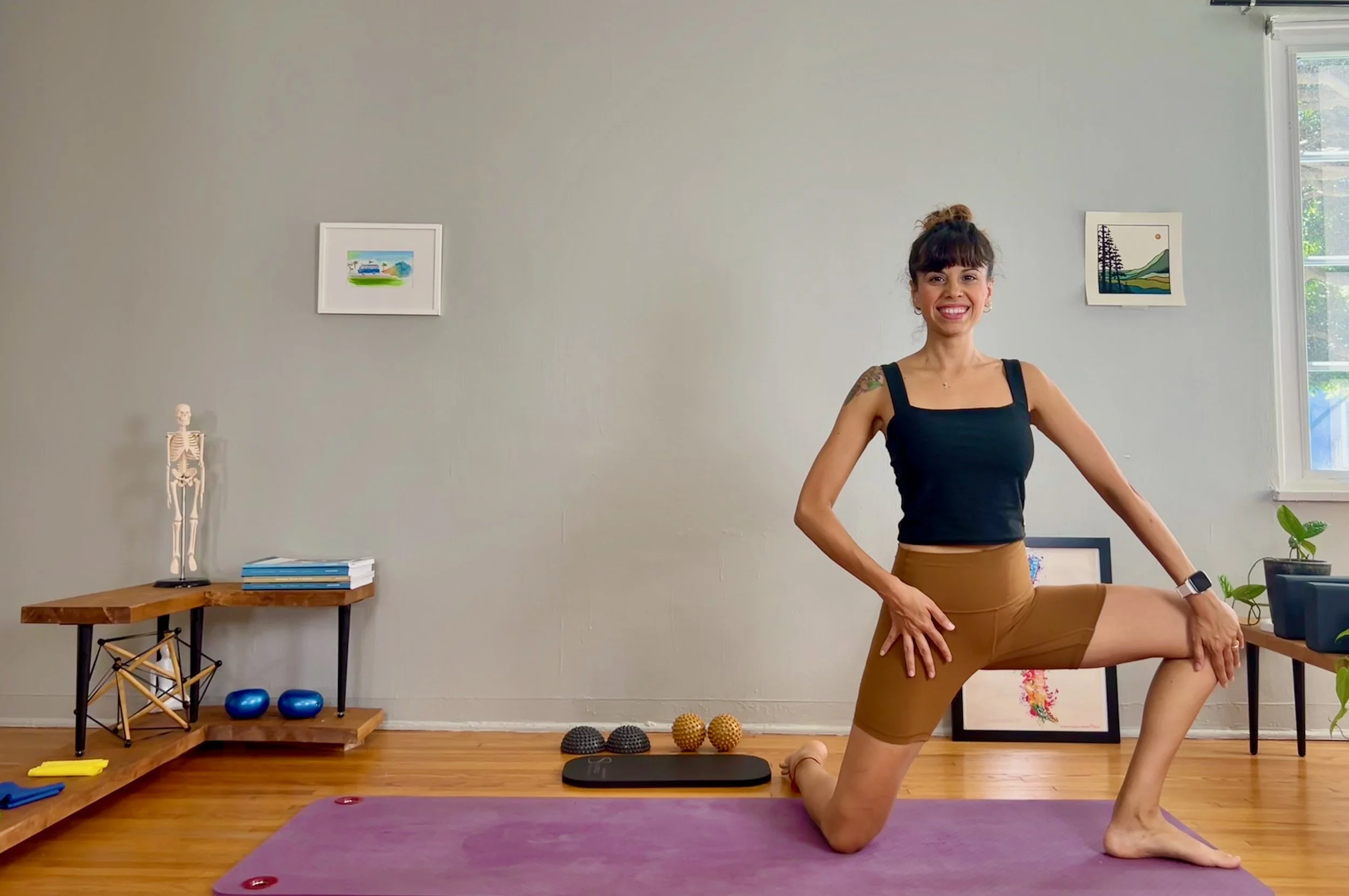
On the mat, the intention is not just to perform exercises, but to train the fascial movement qualities of the body. In FAMO practice, we work with these 12 specific qualities that reflect how fascia senses, adapts, stores, and transmits force throughout the body.
These qualities are not random movement attributes. They are specific to the fascial system and support functional efficiency, movement ease, and freedom in everyday life.
A session that focuses on fascial movement qualities helps create a healthier internal environment—one that supports fluid flow, smooth adaptability, and balanced stability in movement, rather than force and compensation.
Because I work in the movement field, I mainly write about fascia through movement. However, it’s important to remember that fascia is the environment in which all systems operate, including the respiratory, lymphatic, nervous, and digestive systems.
When we positively influence this environment, we often see positive changes across the whole system. This has been my experience, and the experience of my clients, again and again.
Is FAMO about stretching?
First, let’s clarify what we mean by stretching.
If stretching means taking a muscle to its absolute end range and holding it there until relaxation occurs, then no—FAMO is not about that.
In fact, during the 2015 Fascia Research Congress, one anatomist famously said:
“Stretching is the worst thing you can do to your tissue.”
When our goal is to train fascial movement qualities, we usually do not move into extreme end ranges of muscle length. Instead, we use fascia-focused techniques that support elasticity, hydration, glide, and sensory responsiveness.
These approaches often change the feeling of “tightness” without forcing the tissue or overwhelming the nervous system.
Can we isolate muscles while focusing on fascia? Can we isolate fascia while doing muscular training?
No. There is no way to truly separate them.
When we train muscles, fascial layers are always involved. When we focus on fascia, muscles work as fine-tuners for healthy fascial tensioning.
What does change is the intention:
the way we execute the exercise, the targeted fascial continuity, the breath, the pace of the movement, the position of the body, and the quality of internal attention.
When the intention shifts—from muscular emphasis to fascial continuity, or vice versa—the experience of the movement changes, even if the exercise looks the same from the outside.
It’s similar to using the five senses while eating. All of our senses work together to create a complete experience—how the food looks, smells, tastes, and feels. If one sense is missing, the experience changes dramatically.
At the same time, we can choose to focus on one sense. When we do, our perception shifts. Certain flavors become more noticeable, textures stand out, and the feelings connected to that sense may evoke emotions or memories.
Movement works the same way. Nothing is truly isolated, but where we place our attention shapes how we experience what we are doing.
How do I design my sessions?
With over a decade of experience as a Pilates instructor, one thing is very clear to me:
there is no one-size-fits-all approach to movement.
Especially in today’s world, where many of us spend hours looking down at phones or sitting at computers, the body needs more than a single method.
That’s why I don’t teach only Pilates or only FAMO. I combine them—depending on the person in front of me.
For example, if someone wants visible abdominal strength but their thoracolumbar fascia is dense, dehydrated, and lacking glide, no amount of core work will create the desired result. Pushing harder often leads to neck or lower-back discomfort, because other parts of the body have to compensate.
My sessions are designed to address the client’s goals, fascial health, and overall longevity, so strength can emerge without pain, and effort doesn’t come at a cost.
Every session is tailored to the individual—their body, their history, their nervous system, and what they want to feel and experience.
Curious to learn more? Fill out the form below, or feel free to DM or email me (ilkay@ilkaybayatli.com) directly. I’ll get back to you shortly